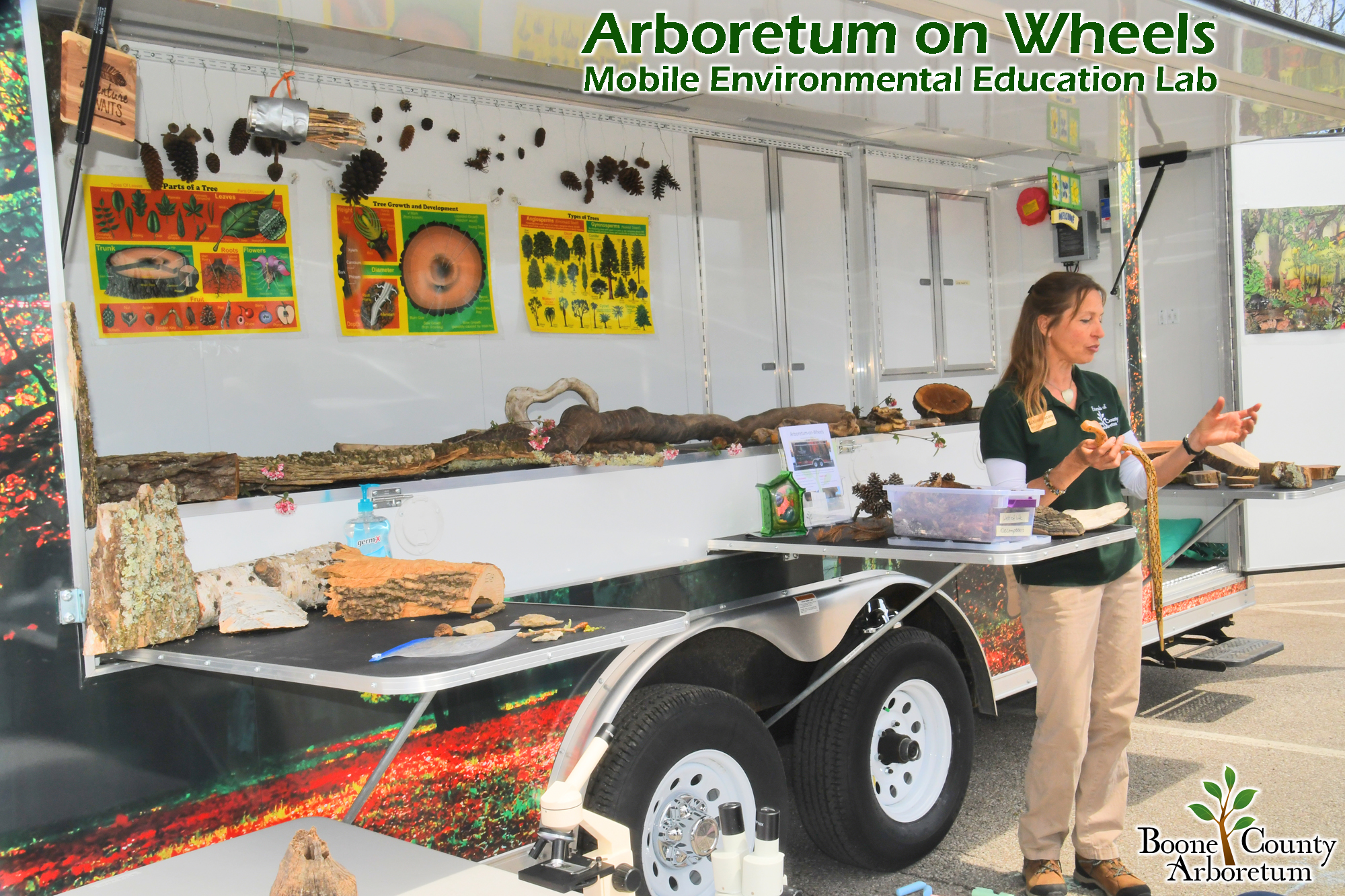
The Boone County Arboretum is an outdoor living museum with a curated collection of over 5,500 trees and shrubs, offering teachers and students rich educational experiences through the Arboretum's programs and tours. Our outreach programs include the Arboretum on Wheels (AOW), an innovative learning laboratory that serves the environmental educational needs of students in the Greater Cincinnati and Northern Kentucky region, directly on their campuses. The AOW lab experience includes an educator who will teach engaging, hands-on NGSS-aligned lessons.
A Unique Educational Resource
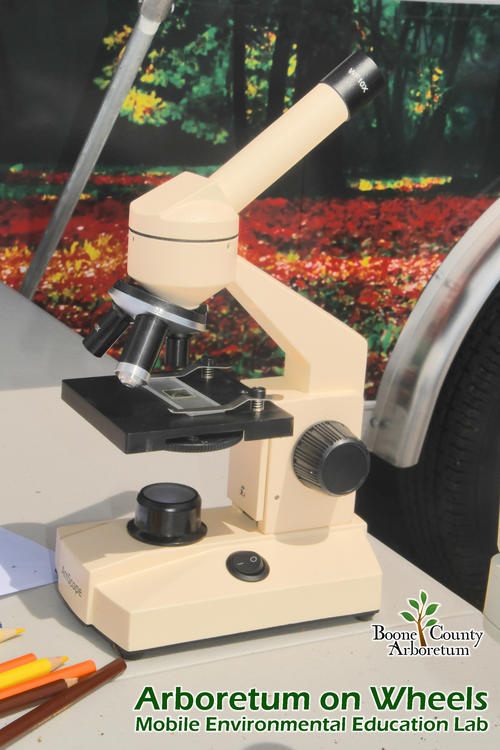
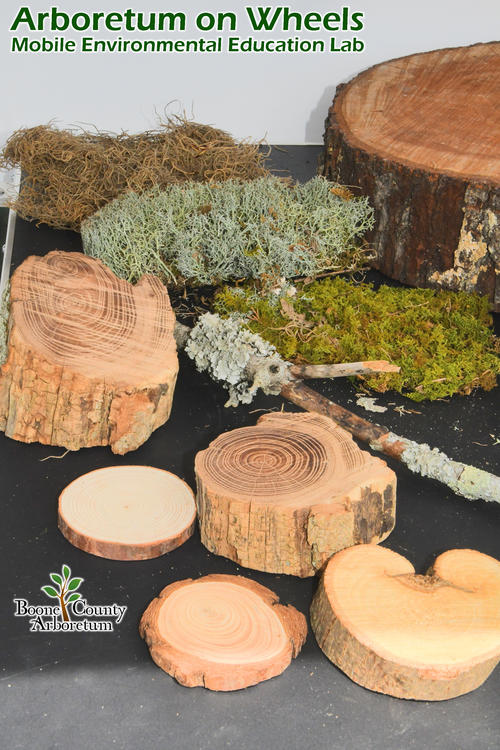
Ideally, when students study the natural world, they are immersed in the environment they are learning about. The AOW brings the natural world to students! It is designed so that our educators can teach lessons from inside the lab, or from anywhere around it using microscopes, models, local trees and plants, and a variety of natural specimens from our collection. If the weather doesn't allow for outside lessons, our adaptable programs can also be delivered inside a traditional classroom.
Elementary to High School NGSS-Aligned Educational Programs
Our elementary to high school programs last approximately 1 hour and work best with groups of 30 or fewer students. The depth and complexity of the concepts presented can be adapted to grade level.
Click the titles for descriptions and information about NGSS Core and Component Idea alignment for each program.
- Elementary: Trees And What They Do
-
Students will learn grade-level appropriate tree physiology (from leaves, bark, and roots to stomata, xylem, and phloem, as appropriate) and be exposed to tree-ecosystem interactions through samples from the Arboretum and/or specimens at the program location. Students will also learn how trees support other living things in the environment and their importance to humans as natural resources. The program culminates with an activity that asks students to determine which of a selection of common household items come from trees. Aligned to NGSS Component Ideas LS1.A: Structure and Function, LS2.A: Interdependent Relationships in Ecosystems, and LS4.D: Biodiversity and Humans
- Elementary to Middle School: Forest Ecosystem Interactions
-
Students will learn about forest ecosystem interactions, with a focus on food webs. Grade level appropriate topics include biotic/abiotic factors, decomposers, primary producers, herbivores, omnivores, carnivores, apex predators, and the 10% rule of energy transfer between trophic levels. Students will interact with animal pelts and botanical specimens from the regional forest ecosystem. The program concludes with the full class constructing an interactive food web. Aligned to NGSS Component Ideas LS2.A: Interdependent Relationships in Ecosystems, LS2.B: Cycles of Matter and Energy Transfer in Ecosystems, LS2.C Ecosystem Dynamics, Functioning, and Resilience, and LS4.D: Biodiversity and Humans
- Upper Elementary to Middle School: All About Insects
-
Students will learn the differences between insects and other invertebrates, basic insect physiology, and insect lifecycles. In addition, students will be introduced to preserved samples of several types of local insects including beneficial and invasive species. Weather permitting, students will be led on an insect collection expedition! Aligned to NGSS Component Ideas LS1.A: Structure and Function, LS1.B: Growth and Development, LS2.A: Interdependent Relationships in Ecosystems, and LS4.D: Biodiversity and Humans
- Upper Elementary to High School: Lichens Up Close
-
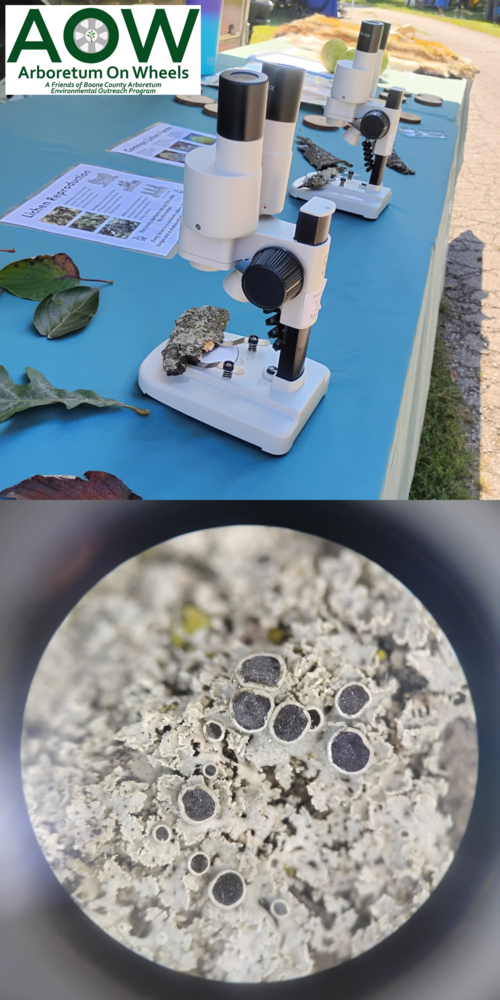
Students will learn about symbiosis, photosynthesis, and fungi by directly investigating multiple lichen specimens. Every student will have the opportunity to observe lichen samples using microscopes provided by the AOW. Upper-level students will practice identifying lichen reproductive structures to learn about differing reproductive strategies among symbiotic organisms. Aligned to NGSS Component Ideas LS1.A: Structure and Function, LS1.B: Growth and Development, LS2.A: Interdependent Relationships in Ecosystems, ETS2.A: Interdependence of Science, Engineering, and Technology
- Middle to High School: Leaves and Climate Through Time
-
Students will learn how climate shapes organisms by studying the relationship between average annual temperature and leaf morphology and learn how paleontologists use this relationship to reconstruct Earth’s past climate. This program incorporates data collection, analysis, and interpretation. Aligned to NGSS Component Ideas LS1.A: Structure and Function, LS2. A: Interdependent Relationships in Ecosystems, and LS4.C: Adaptation
Early Childhood Programs
Our early childhood programs last approximately 30 minutes and work best with groups of 20 or fewer children. We encourage larger groups to schedule two or more sessions back-to-back to allow every child to have a hands-on experience during the program.
Click each title for program details.
- Early Childhood: Who Lives in a Tree?
-
Students will learn about the animals and other plants that trees support through story, song and dance, investigating Arboretum specimens, and outdoor exploration (weather/site permitting).
- Early Childhood: Oh, to be a Tree!
-
Students will learn about tree parts by comparing them to their own bodies through story, song and dance, investigating Arboretum specimens, and outdoor exploration (weather/site permitting).
New / Custom / Other Programs:
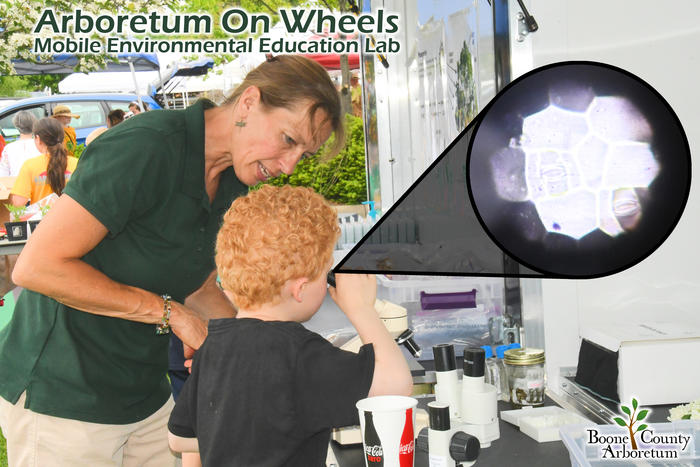
The above is just a sampling of the Arboretum on Wheel’s formal education programs. New and custom presentations are constantly being developed, including for homeschool cooperatives. Our informal, generalized programs are popular for a wide variety of community events and organizations. These programs include a hands-on experiences, with material and discussions for all age groups. Please reach out to us, and we'll be happy to accommodate your group's needs.
Booking the Arboretum on Wheels
Elementary to high school programs are designed for a 1-hour class period with groups of 30 or fewer students. Early childhood programs last approximately 30 minutes, and work best with groups of 20 or fewer students. The standard rate is $225 for the first hour, and $100 for each additional hour at the same location on the same day. A mileage fee applies for locations that are more than 25 miles from Burlington, KY.
If you are interested in having the Arboretum on Wheels program visit your school or community event, contact us with some target dates or if you need any additional information. Once we have confirmed your date and program, you can then pay for your reservation using a credit card (an online payment link will be provided) or check.
The Visionaries Behind the Arboretum on Wheels
The AOW lab is operated through the Friends of Boone County Arboretum (FBCA) "Educational Outreach Fund." FBCA is a non-profit organization dedicated to advocating for and advancing the Arboretum's mission in the community. A collaboration of private donations to the 2017 Growing Forward Campaign and a grant from the Elsa Heisel Sule Foundation brought the AOW from just a vision into reality.
Keep Our Wheels Rolling
Want to help students have a rich educational experience through the AOW program? Corporate sponsorships and gifts from individuals to the Friends of Boone County Arboretum Educational Outreach Fund, will be used for a scholarship to provide discounted program rates to qualifying (need-based) schools, and will help ensure the AOW has ample educational resources to carry out its program.